

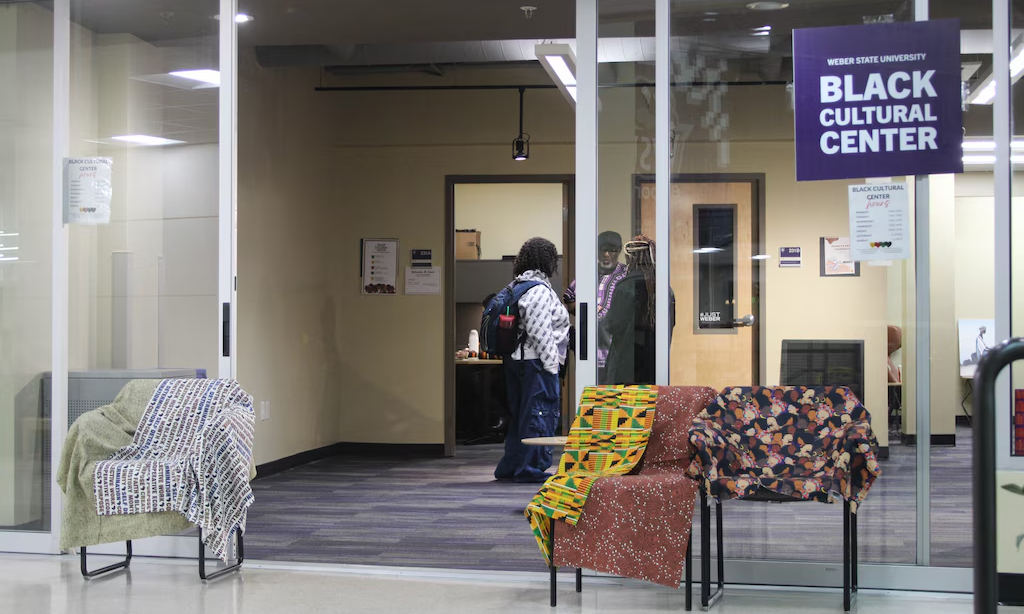
Ogden • The elimination of identity-based organizations at Weber State University — everything from the LGBTQ+ Resource Center to the Black Cultural Center — is still being felt across the Ogden campus, students who relied on those places say.
“The closure of the cultural centers on campus was a really sad loss for all students. It sent a message that marginalized communities are unwelcome,” said senior Daniela Torres-Roe, who had previously engaged with the Women’s Center on campus.
The closures — which came after the Utah Legislature passed HB261 to eliminate diversity, equity and inclusion (DEI) programs at the state’s public institutions — have made it harder for students to find resources based on their identity groups, and left many feeling unsure where they fit on campus, Torres-Roe said.
After the Utah Legislature passed HB261 in January 2024, Weber State officials decided to go a step further than the law’s requirements, and eliminate identity-based centers — such as the LGBTQ+ Resource Center, the Dream Center, the Black Cultural Center, the Native American Cultural Center and the Pan-Asian Cultural Center. The centers’ resources were consolidated into a new Student Success Center, meant to serve all students.
While HB261 did not explicitly require the closure of identity-based centers, Brad Mortensen, then the president of Weber State, wrote in a 2024 Salt Lake Tribune op-ed that the law’s restrictions would have limited the centers’ ability to provide services and “set them up to fail.”
Mortensen, who left Weber State to become president of Utah State University in November, described the decision to close them as “painful,” but said the university chose to shift toward a model focused on supporting all students.
The bill’s sponsor, Rep. Katy Hall, R-South Ogden, has said HB261 protects open dialogue and promotes equal opportunity. “I absolutely believe in inclusion, but I don’t believe in inclusion at the expense of exclusion,” Hall said in a 2024 YouTube interview with Cari Bartholomew, a school-choice advocate and former Utah State Board of Education candidate.
The newly created Division of Student Access and Success was not created to replace the old Division of Equity, Diversity and Inclusion, said the new division’s former vice president, Jessica Oyler, but to bring together student support services. Staff was reassigned to new roles, Oyler said, including positions in the new Basic Needs Center.
Brandon Flores, executive director for student retention and success, said the transition “was a difficult shift, because some positions and programming were tied directly to identity-specific services.”
“We worked to maintain support while ensuring compliance with the new law,” Flores said. “Your initial reaction to the transition is of frustration and confusion, especially from those who benefitted from the centers and the staff that worked there.”
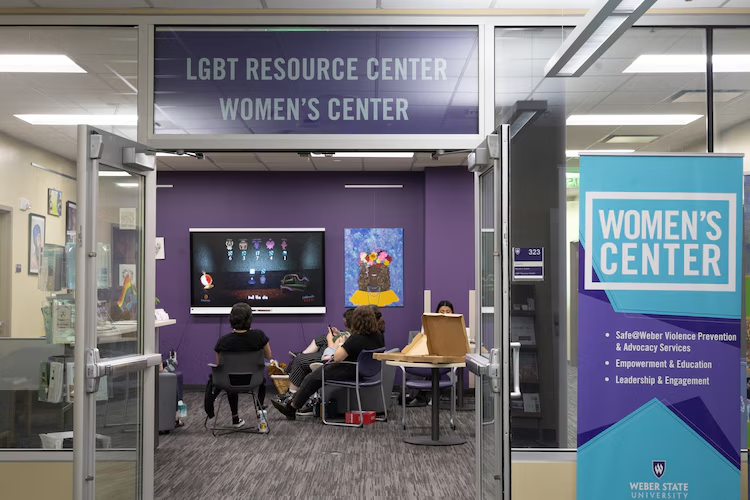
(Kennedy Camarena | The Signpost) Weber State University students hang out in the former site of the LGBT Resource Center and Women's Center, one of several identity-based campus organizations that closed in 2025.
Finding it hard to connect
For students, though, the loss of identity-based spaces had an effect, one some didn’t see until they were gone. For many, they were more than simply offices, but spaces that catered to distinct communities with unique needs — providing academic guidance, organizing cultural events, providing mentorship or just a place to exist without explanation.
Jose Barut, a senior majoring in computer science, said the transition made it difficult to form the cultural connections he expected to find at Weber State.
“I thought it could be easy to connect with others by joining the Asian Club or Filipino Club, but I couldn’t find them at all,” Barut said.
Barut said that he has only interacted with the Student Success Center because he became more active in campus activities and groups. From there, he met new advisers and students.
“Having gone through the effort of trying to find identity-related support or advocacy services has been a struggle. I feel like a place with Asian in the name would make it easier to find something,” he said.
Anayeli Rodriguez, president of the Hispanic Area Council, described a noticeable decline in student engagement. Rodriguez has been a part of the council for several years, and she said she has watched participation shift as programming became harder to promote without a designated space.
“Without a physical space, fewer students know where to go for cultural events,” she said. “We’ve tried to hold smaller social gatherings to keep the community alive, but there’s less visibility overall.”
Staff on campus also felt the effects of the transition. Safe@Weber program administrator Jess Pleyel said the restructuring changed how their office operates, such as discontinuing intersectional feminine programming and events. Safe@Weber, once housed within the Women’s Center, now operates as a standalone program, she said.
Even with the changes, Safe@Weber continues to see growing demand. “Our numbers relating to violence prevention and advocacy continue to grow. Last year was our busiest year for advocacy in history,” Pleyel said. “Our advocacy services and violence prevention have been and always will be for any student, staff and faculty.”
A lack of representation?
For students like Angela Barradas, a senior majoring in graphic design, the shift has changed how campus discussions happen.
“I actually worked at the new Student Success Center,” Barradas said. “There was still some form of support, but it genuinely felt as if everyone had to walk on eggshells. … Certain conversations were not allowed and deep questioning was often discouraged. The environment was just not the same.”
While the Student Success Center provides general support, some students said they feel the personal connection and cultural representation are missing.
“The presence of DEI and identity centers is not simply about meeting a current need,” said one student, a former peer educator, who insisted on anonymity because they were concerned about retaliation from the university. “Students flourish when they are able to bring their full selves into an environment that affirms their identities.”
The university has made efforts to maintain engagement, hosting events like Diwali celebration and Hispanic Heritage Month. However, Rodriguez, from the Hispanic Area Council, said it’s not the same.
“We hope one day to have our center back, but that’s not realistic in the short term,” she said. “For now, we focus on connecting with students wherever we can.”
As Weber State continues to adapt to HB261, its long-term effects on campus culture remain uncertain. Some students appreciate the focus on broader academic resources, but for many, the loss of these identity-based centers has left a gap in community, belonging and representation.
“Support looks different for every student, but every student should know they can come to our staff and find that support when they need it,” Flores said. “We work hard to get ourselves out there and stay visible, because those connections build trust.”
Mia Salgado wrote this story as a journalism student at Weber State University. It is published as part of a new collaborative including nonprofits Amplify Utah and The Salt Lake Tribune.
