

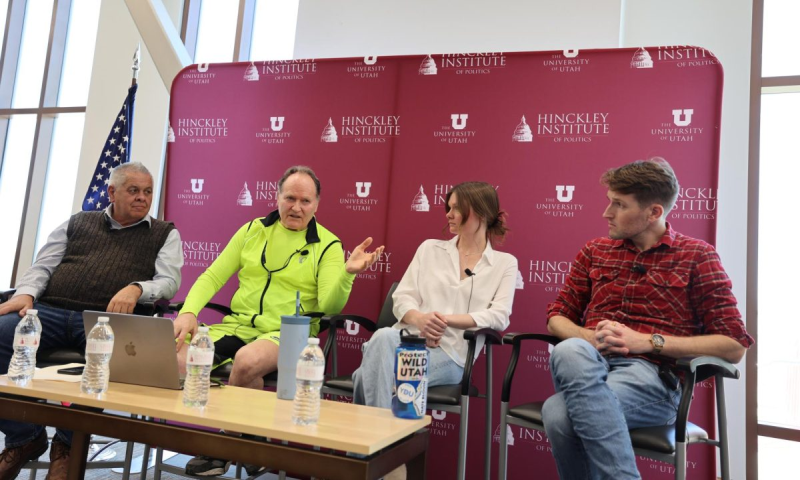
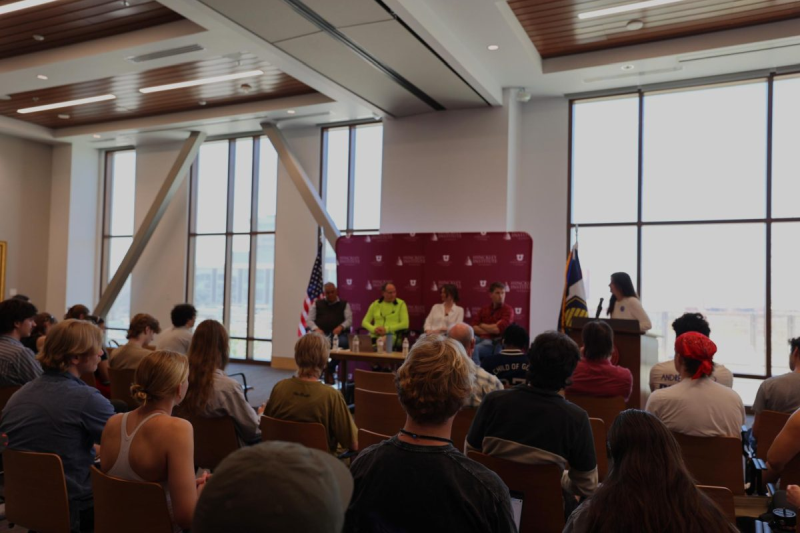
As conservationists estimate the Great Salt Lake will fall to new record lows later this year, the ASUU sustainability board’s Wednesday panel hosted prominent local conservationists in Gardner Commons, including a physician, environmental activists, a lawmaker, and an Indigenous scholar.
With over 50% of the lakebed exposed, the Great Salt Lake is only 36.7% full. Panelists warn the consequences of a shrinking lake already extend far beyond the lake’s shoreline — including worsening air quality, high economic costs and additional public health concerns along the Wasatch Front — and will continue to intensify as the lake dries up.
Four panelists, Dr. Brian Moench, Darren Parry, Alta Fairbourne and Nate Blouin participated in the event.
Public health
The exposed lakebed contains heavy metals and toxic dust that, when blown into the air, worsen the Salt Lake Valley’s already poor air quality. Dr. Brian Moench, president and co-founder of Utah Physicians for a Healthy Environment — the largest civic organization of health care professionals in Utah — described the situation as “a toxic soup.”
“The health hazard is under analyzed, under researched, and under reported,” Moench said, referencing “chemical interactions between the dust and the regular urban air pollution that we’re familiar with, creating new chemicals that we didn’t even know existed.”
A 2020 report from Brigham Young University estimates that long-term exposure to Utah’s dirty air can shorten one’s life expectancy by 1.1 to 3.6 years, causing between 2,500 and 8,000 premature deaths each year.
Panelists speak at “This Concerns U” Great Salt Lake event hosted by ASUU on March 25, 2026. (Photo by Will Ruzanski | The Daily Utah Chronicle)
“There are 28 sewage treatment plants that discharge into the Great Salt Lake, either the lake itself or its tributaries,” Moench added. “All the toxic byproducts of modern civilization are in the lake and the lake bed.”
A retired anesthesiologist, Moench recommends using an air purifier in the bedroom and an N95 mask when the valley’s air quality is particularly poor.
Environmental conservation
Alta Fairbourne, community water organizer for Utah Rivers Council — a grassroots nonprofit dedicated to water conservation — argued conservation strategies are not drastic or “draconian.”
“We don’t need to dry up every single farm in Utah,” she said. “We don’t need to get rid of every single piece of grass. Utah’s the highest per person municipal water user in the country.”
Utah residents consume the most domestic water per capita in the Southwest United States, according to the Salt Lake Tribune. The same article says “Utah’s public supply customers use the most water per capita in the United States,” while paying some of the lowest water rates.
“It’s a false dichotomy to say that we have to prioritize our economy or the environment,” Moench said. “They’re very much one in the same.”
Fairbourne criticized what she described as the Utah Legislature’s lack of serious, material legislation focused on Great Salt Lake water conservation, saying that “I think that’s kind of pacified this fiery public resistance that I truly believe that we need to save the Great Salt Lake.”
“Without a critical eye, it can feel really self assuring that there’s people coming to save us,” she said. “This is a drastic and serious crisis that we are facing in northern Utah, and we need big policy change.”
As a community water organizer, Fairbourne added that she has “definitely been seeing a lot of positive change,” saying she thinks “a lot of people are becoming really aware of the declining Great Salt Lake.”
Activism
All four panelists encouraged audience members to join a grassroots advocacy organization to push for environmental conservation.
“It must be addressed, or it will never get any better,” Moench said, encouraging “public pressure in every way possible, protest, writing letters, calling your legislator, everything.”
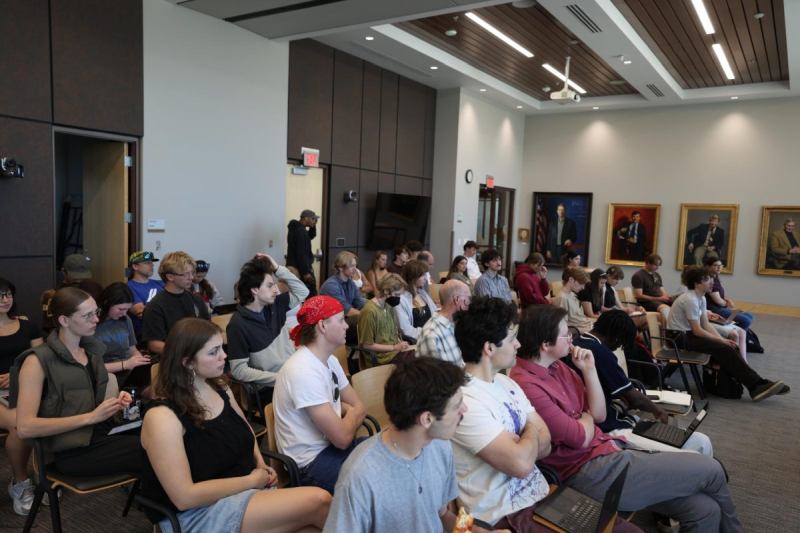
Students attend ASUU panel about Great Salt Lake on March 25, 2026 in Gardner Commons (Photo by Will Ruzanski | Daily Utah Chronicle)
Darren Parry, former chairman of the Northwestern Band of the Shoshone Nation, said that “everybody needs to be involved in [Great Salt Lake conservation] in some way to have that stake in their future,” arguing that tribal leadership is key to land stewardship.
“It’s not a science problem, it’s a values problem … we need to reframe how we look at the issue and get back in tune with nature,” Parry said. “Now we’re looking at the lake not as a resource that we can extract, deplete, develop, use, divert, but we look at as our relative, that we nurture and care for, we need to advocate.”
Utah State Sen. Nate Blouin, D-Millcreek, a progressive candidate running for Utah’s newly drawn first congressional district, emphasized that “this is going to be a problem that requires federal solutions.”
During the Utah Legislature’s 2026 General Session, Blouin sponsored multiple bills aimed at water conservation for the Great Salt Lake, all of which failed. Blouin expressed his desire for more local oversight for the Great Salt Lake, rather than state regulation.
“This is where our population center is, and our voices get left out so much, just based (on) who chairs some of these committees,” he said. “We need to get the young folks involved who are going to be impacted, the tribes that have the knowledge … the public health folks who certainly know about the impact here to our communities.”
Will Ruzanski wrote this story as an emerging journalist at the University of Utah. It is published in partnership with nonprofit Amplify Utah and The Daily Utah Chronicle along with the Great Salt Lake Collaborative, a solutions journalism initiative that partners news, education and media organizations to help inform people about the plight of the Great Salt Lake — and what can be done to make a difference before it is too late. Read all of the collaborative’s stories at greatsaltlakenews.org.
###
NOTE TO MEDIA PARTNERS PUBLISHING WORK
We also request organizations include the following text either at the beginning or end of the story text: This story is jointly published by nonprofits Amplify Utah and [Your Media Organization's Name] to elevate diverse perspectives in local media through emerging journalism. Caitlyn Homolya wrote this story as a journalism student at the University of Utah. For more stories from Amplify Utah, visit amplifyutah.org/use-our-work.
