

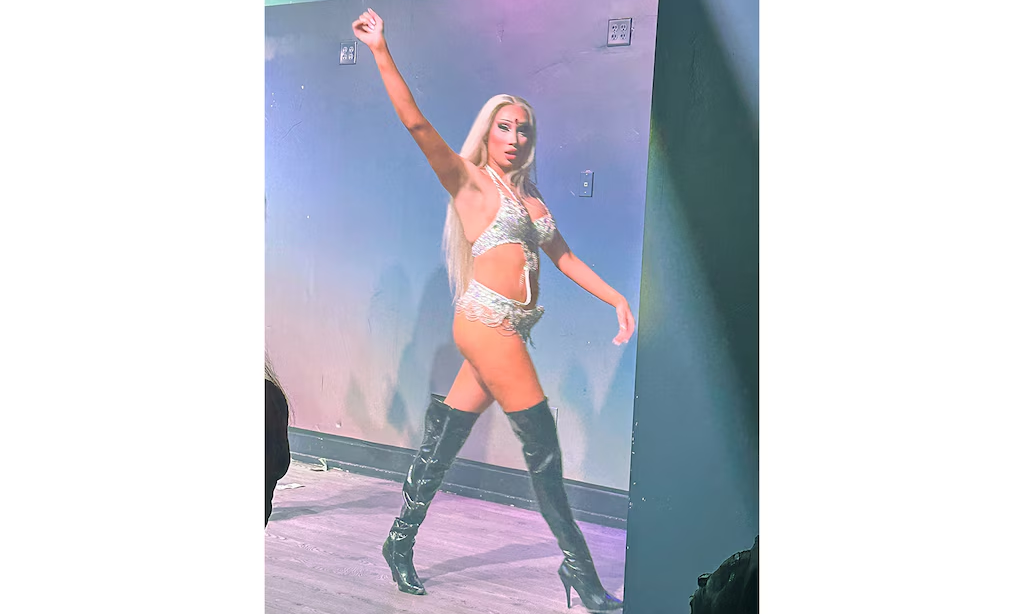
Salt Lake City is home to a thriving and diverse drag community, according to some of its members, who say its growth isn’t despite the dominance of The Church of Jesus Christ of Latter-day Saints in Utah, but because of it.
“A lot of, weirdly enough, Mormon culture does kind of play into why it’s such a unique scene,” said drag performer Mik Jäger. (All the performers in this article are identified by their drag names.)
“We’re like, about five or six hours from Vegas, six to eight hours away from Denver. … We [are] all just kind of stuck in the desert together,” said Jäger, who’s been performing since 2021.
“There’s always been a long history of drag and counterculture here in Utah, because we’re the headquarters of the church,” Jager said. “What makes it empowering — especially if you grew up in the church and you exited Mormonism — there’s just a certain camaraderie that goes with that, choosing to live how you want.”
Another performer, who goes by Katie, Party of 2, said, “Salt Lake is such an art-driven scene in general, which may be surprising to some people. … And Salt Lake is such a safe haven for queer people that I feel that need and drive for that art and that community base.”
The diversity of Salt Lake City’s drag scene has grown immensely in recent years, according to its participants. The community has welcomed more transgender queens, AFAB (assigned female at birth) queens, kings and nonbinary performers dubbed drag “things.”
“There’s been a lot of work done in the past few years to include performers of different styles, to not just drag performers that are kings or things, but burlesquers [and] musicians,” said Hardy Harr, a drag king based in Salt Lake City. “I do feel like, as a community, we’re pretty good to each other.”
Katie, an AFAB queen who has performed since 2023, also cited the camaraderie of Salt Lake City’s drag performers. “We really draw inspiration from [the] community,” Katie said, ”and just the strength that we get from each other and support we can give to each other."
Banding together
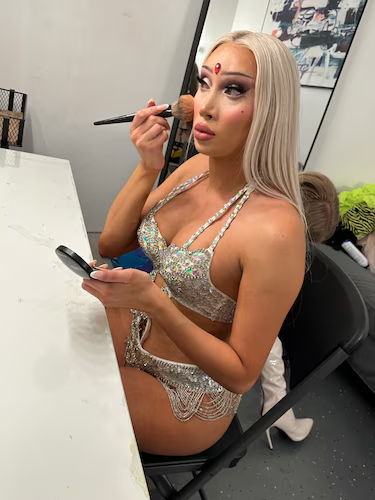
(McKinna Baird | The Signpost, Weber State University) Drag performer Barbin prepares for a performance at Milk+ in Salt Lake City, March 21, 2026.
That community has persevered through much opposition in recent years. According to a study by the Institute for Strategic Dialogue, an independent research group, the U.S. has had more than 200 anti-drag mobilizations in recent years — from online and offline threats to protests and acts of violence.
In 2022, a Salt Lake City tea shop hosted a series of all-ages drag performances, which drew attention from the social media group Libs of TikTok — as well as a January 2023 protest from the Proud Boys militia group, some of them armed, The Salt Lake Tribune reported. The tea shop stopped hosting the drag shows, and show organizers returned to a different venue, with a group called Armed Queers of Salt Lake City providing security.
In March 2023, members of a group called Southern Utah Drag Stars were denied a permit to perform an all-ages show in a St. George park. The group sued two months later, and, in February 2025, the city settled with the group, acknowledging that it violated the group’s First Amendment rights.
According to one drag queen, Gaye, a drag show last fall was canceled a few days after conservative commentator Charlie Kirk was shot and killed on Orem’s Utah Valley University campus in September. “The cancellation,” Gaye said, “was chalked up to safety.”
Gaye, who has been performing for a decade, said performers felt safest walking in drag in the city, as opposed to surrounding suburbs. And, despite the reputation of rigorous security at the Utah Pride Parade, that is where they have felt the most unsafe. “It’s out in the open, and there’s not any bouncers.”
“I feel like there’s no separation from church and state here,” said Barbin, a full-time drag queen in Salt Lake City. “In a town like this, a lot of LGBT people are oppressed just by being themselves.”
Different kinds of drag
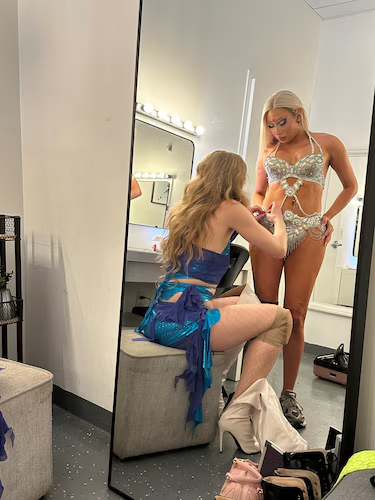
(McKinna Baird | The Signpost, Weber State University) Drag performer Barbin prepares backstage at Milk+ in Salt Lake City, with performer Danny Keyes helping pin her costume, on March 21, 2026.
Salt Lake City’s drag community offers a wide range of performance styles and personal backgrounds.
Take, for example, Barbin, who is a transgender woman. She recently started a recurring drag show at the bar MILK+, which features an all-trans cast. “I feel like now, in 2025, we have great trans entertainers here in Salt Lake City, and their drag is amazing,” Barbin said. “So I was like, ‘You know what? Why don’t we just do a show?’”
Besides hosting at MILK+, Barbin has increased her visibility by traveling to other states, and by working in shows with touring queens. In October, she performed with Sasha Colby, the winner of Season 15 of “RuPaul’s Drag Race.” For Halloween, she performed with another “Drag Race” alum, Bosco.
Gaye prefers a cabaret-style show, influenced by jazz and her musical theater background. She performs at bars around Salt Lake City and hosts entertainment at Prohibition in Murray. She also has opened for musician and YouTube performer Todrick Hall, a past judge on “Drag Race” and a performer on Taylor Swift’s video for “You Need to Calm Down.”
Gaye is a “drag mother” to several Utah performers, such as Katie, Party of 2. Gaye nudged Katie and other queer performers into drag, Katie said.
“I play with drag and transformation,” Katie said. “Some people think that you have to have a gender transformation to do drag, and I personally don’t believe that. I think any sort of transformation that you have can play into the art of drag.”
Katie said she aims to infuse a sapphic energy into her performances, whether that be through song choice or engaging with her female audience.
Drag kings are less mainstream, but also part of the scene. One of them is Hardy Harr, who infuses dad rock and all things camp into his performances.
“No matter the performer, you’re still bringing something unique,” he said. “And we don’t all have to do the exact same thing for it to be valid or interesting.”
Like most drag artists — and as his stage name implies — Hardy Harr wants to offer moments of joy to his audience. “I want to elicit laughter,” he said. “I want to make people experience joy with what I put together.”
Mik Jäger presents a more masculine esthetic and uses he/they pronouns. They call their drag style that of a “huge millennial.” Their onstage esthetic also reflects their Asian and Pacific Islander identity.
“I take a lot of inspiration from anime and Kabuki-type styles of what men look like,” they said.
Gaye is a seasoned queen, and has seen Salt Lake City’s drag scene ebb and flow over the years.
“[There are] all of the different kinds of facets of drag you get nowadays,” she said, “but Salt Lake has just always been so eclectic. We’ve seen so many different iterations of the drag scene here.”
Note to readers • McKinna Baird wrote this story as a journalism student at Weber State University. It is published as part of a collaborative including nonprofits Amplify Utah and The Salt Lake Tribune.
###
NOTE TO MEDIA PARTNERS PUBLISHING WORK
We also request organizations include the following text either at the beginning or end of the story text: This story is jointly published by nonprofits Amplify Utah and [Your Media Organization's Name] to elevate diverse perspectives in local media through emerging journalism. McKinna Baird wrote this story as a journalism student at Weber State University. For more stories from Amplify Utah, visit amplifyutah.org/use-our-work.
